Sunday, January 1, 2012

Athens, Greece: Natural Sustainability

Hello fellow blog followers!

We just left Athens and are now safely in our hostel in Rome. But I am here to reflect on my say in Athens, Greece.

I wanted to first talk about how its best to talk to locals when you want to gather the most interesting information. We took a free walking tour given by a nice chap named George, as we were walking he pointed out that Athens built over the waterways. They had no real reasoning behind it so it completely turned me off. Smog there is already off the charts so acid rain comes along. I thought of all the acid rain that drains through the city and has no plant life to filter it, the rain falls right into the main waterways.

Most of the main plant life I saw were in parks such as the National Gardens and potted plants on porches of apartment buildings.

Also I wanted to talk about Greece's way of sustaining their natural history. I understand that Greece isn't in the best economy state, but historical ruins sustainability is a big part in any countries/cities tourist income.  What I observed while touring is that most of the popular ruins were not properly taken care of, many pieces of marble were sorted and stored off to the side and people were free to roam about as they pleased. It was nice not having to stand in line to take turns for pictures but I thought it would be more beneficial if they had more control.

Also plant life in Athens was poor, and the area inside and outside of the city was not well kept, and the soil looked depleted and the highly urbanized areas seems to take over everything. Also many stray dogs and cats were found all over, as well as their feces (adds to rain water run off). Pigeons as well seemed to be over populating the city, Pigeons carry many diseases which can have an effect on water pollution and air pollution.

Athens was not the best place to travel to, but many of the locals said it is better to tour in the summer time. But I am glad we got to experience part of the real Athens life without heavy tourism going on.
I conclude that Greece isn't able to sustain a healthy environment for its natural plants and animals and as well as their inspiring history, due to their economic state. But I hope that in the future when they are able to bounce back they will not only focus of reshaping their economy but they will also realize how much they need to take care of their natural resources. 

Saturday, December 31, 2011

The National Garden

While in Athens, we visited the National Garden. Unfortunately, we were only able to visit a small portion of it. However, I could not help but notice that various areas of the ground were raised to what looked like little underground tunnels. I took this as the defense to combat erosion since the city does not have any natural waterways. In fact, Athens has built over all three of its natural rivers.
While on our tour of the garden, we were told that the Queen who commissioned it's design imported over 500 species of plants and animals. Many of those plants were found to not be able to survive in the Mediterranean climate, however, those plants and animals that did survive have now become a part of the surrounding landscape. For instance the duck population has become overrun not only affecting the life of plants in the National Garden but also ducks can be seen throughout the city. We found all of this interesting since it could have a huge impact on people's health within the city.

Friday, December 30, 2011

So far, Athens has been good to us. =]

Today, we first took a Free Walking Tour (for all those planning to travel Europe, this is a really awesome concept- most of the major cities on the continent have a totally free walking tour! So just google whatever city you're planning on going to and find the free tour!). Our guide, George, gave us a really brief outline of the city and it's major, mostly historical, landmarks. The tour ended at the acropolis, after we had seen sites like the Roman Agora, Hadrian's Arch and the Temple of Zeus; we proceeded to explore the acropolis, taking in the Parthenon, the Temple of Nike, and other relics.

We were sitting at the top of the acropolis, looking at the remains of ancient Greece with modern Greece sprawling past the horizon behind it, when we started to wonder just how much this is costing the country and how they're preserving these relics when they're in such a deep recession. As well, the Greeks are petitioning the British- who have a large, very well preserved piece of the Parthenon on display the at British Museum (that we're going to see!!)- for the part of the Parthenon they took many years ago. However, the British Museum has provided a many number of reasons for why they can't return it. This has led to Greece building newer research facilities and museums so that they could better house the missing pieces. Is it possible though, that Britain could use Greece's current economic strain as another reason to not return one of their largest exhibits? Someday, when I can get internet with enough "umph" to actually download videos, I'll show you guys some bits of conversations we've been having about Greece.


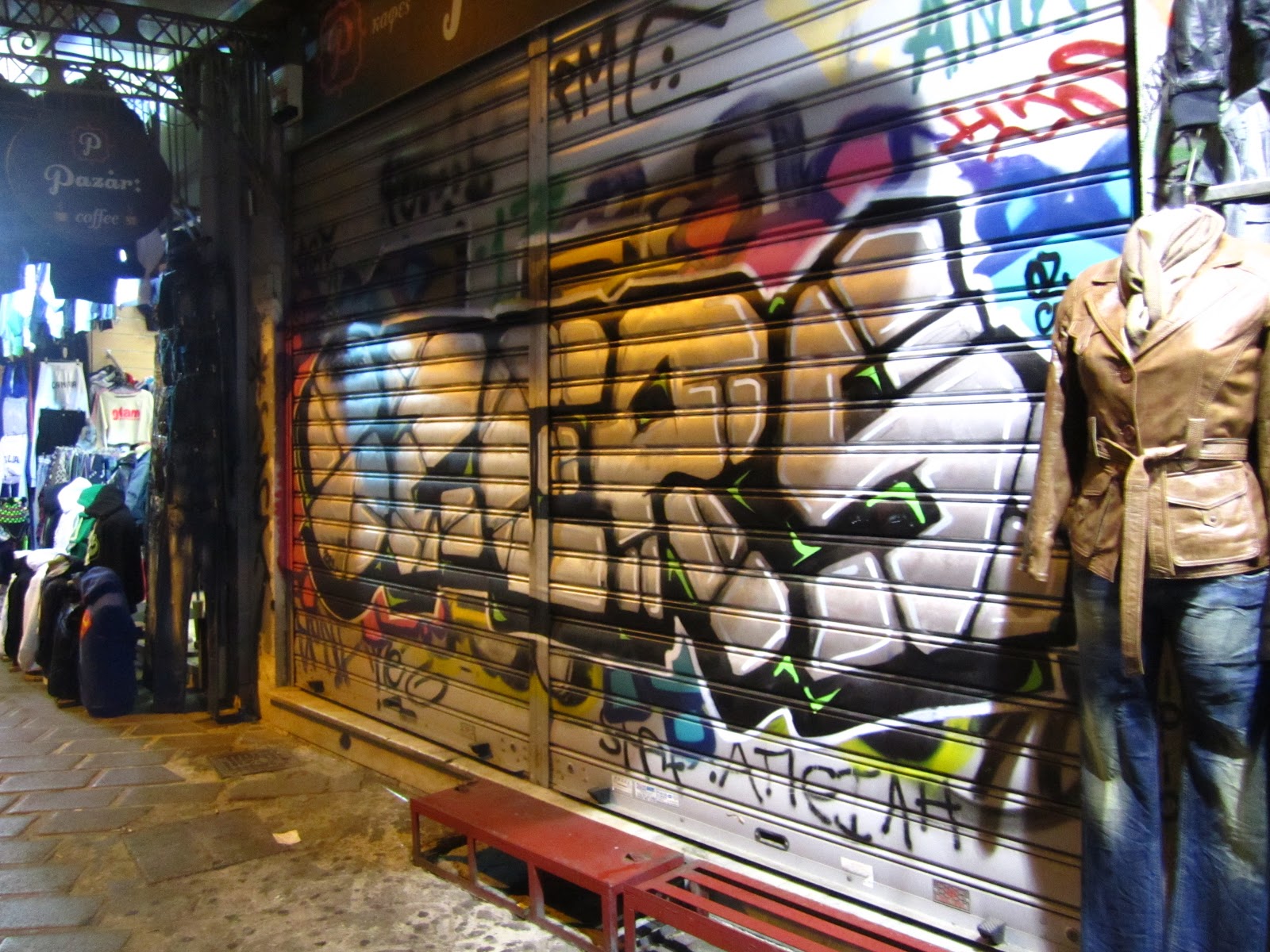
Graffiti close to Monastiraki Station.


The Parthenon on the Acropolis.


A view of the city of Athens (ancient and modern cites!).


Thursday, December 29, 2011

Luk and I waiting for Muk at the airport!

Sorry, I messed up and didn't save the first video we recorded when we got to the airport!
But this one is just as good! : )

Today we all finally made it safely to Athens, and tomorrow we will be posting another video and we will be starting our regular blog schedule (each of us posting a blog, 1 every 3 days).

Tuk

Thursday, December 15, 2011

No need to worry Willie...


Luk, Tuk, and I are hugely enthusiastic Willie Nelson fans. Not only is he a boss on the guitar and has the voice of an angel but he is also striving to reduce his own carbon footprint and that of the United States. Willie Nelson has created his own brand of alternative energy called BioWillie. "I knew we needed to have something that would keep us from being so dependent on foreign oil, and when I heard about biodiesel, a light come on, and I said, 'Hey, here's the future for the farmers, the future for the environment, the future for the truckers, it seems like that's good for the whole world if we can start growing our own fuel instead of starting wars over it." You make a great point, Willie.

So on our excursion of Europe we will find ourselves with an entire glorious week in Italy. Rather than spend all of this time in Rome we decided to do a bit of exploring. So being our savvy selves, we decided to rent a car (a Fiat Panda) and drive from Rome to Florence and then onward to Venice and finally back up to Rome to snag our plane ride to the fair city of London. Being environmentally conscious as we are, we have decided to "feed" our Fiat Panda with biofuel whenever possible! Italian chemical groups Mossi & Ghisolfi broke ground on a 13 million gallons per year plant at Crestentino in northwest Italy. Production will begin in January and the new biofuel is predicted to reach most fuel stations. Biofuel is a non- petroleum based fuel composed of natural sources such as algae, animal fat, or vegetable oils. One major advantage of this type of fuel is that it is clean burning and renewable (unlike petroleum). Studies indicate that it can reduce tail pipe emissions by 80%. YOWZA!


Wednesday, November 30, 2011

Luk's Global Communication and Media Project.

I have this Facebook friend who posts some of the best links on his profile page. He's literally done half the research for one of my papers because when he posts the link, he also posts his opinion on it which, as you may know, can be highly productive in getting through writer's block (and no, I don't plagiarize this poor guy...). The coolest thing about this is that this is a Facebook friend who I wouldn't see on a regular basis because we live in different countries. 


You guys may have heard about the "Facebook Revolution" that happened in Egypt? Part of the Arab Spring, per chance? These mass protests and political coups were organized through the online networking site Facebook. The Facebook group that sparked the revolution in Egypt? Formed in America. The world is becoming more connected. Because of this, ideals are being more quickly shared and in that, assimilating to the same basic principles. On a macro scale, this means that democracy, and likely with it capitalism, is moving its way into more and more countries around the world.


So how does the Middle East apply to Europe? Connectivity, my friend.

The same guy who's been doing my research posted a link about how Iceland re-wrote their constitution over the internet. Consequently, I decided to make my Global Comm and Media project on how this same concept can be applied to Greece. If you're reading this, I feel that it is safe to assume that you know Greece is fixing to default something major on a shit ton of loans. However, could this situation be bettered if the people of Greece were allowed to re-write their Constitution, like the Icelanders, and decide their own fate- as opposed to the owners of their bonds and treasury bills? Is it possible that Greece is even in a place technologically, socially and politically where the country would benefit from such actions? 


I guess what you think depends on where your money is.


Monday, November 7, 2011

Killer Algae!!!

Don't worry, no poorly acting damsel in distressed or flailing armed monster here...just the invasive specie, Caulerpa taxifolia.

Caulerpa taxifolia gets the name Killer Algae from being highly adaptable to any habitat, rapid growth,  and capabilities to produce high concentrations of toxic secondary compounds, out-competing native seaweed species.

The algae is popular for being aquarium tank decoration. In the early 1980's  a professor at the University of Nice-Sophia Antipolis (France), found a patch of the algae in front of the Oceanographic Museum in Monaco. Theories say the algae was released after an aquarium cleaning. (Analysis showed that it was the genetically altered aquarium specie not the wild strand, so natural dispersion is not an option)

Once introduced to the Mediterranean it easily multiplied throughout the coastline due to anchors, fishing nets, and dumping ballast water.
Its has a  highly toxic chemical defense, so it's barely eaten by herbivores, having no competition the average growth rate is 1 cm per day.

The species is conflicting with many ecosystems, threatening biological stability in the marine environment. Caulerpa taxifolia is known to kill many fish species, it also is harming tourism, decreases the pleasure of boating, recreational, and has a financial impact on commercial fishing.

The removal process:
Many removal ideas have been tested, to manual removal, suction pump, hot water, electrolysis with copper electrodes, copper ions through an ionic selective membrane, and the use of chlorine. Some biological control ideas are to introduce grazing tropical species but it might lead to unexpected consequences.
But the most effective methods of removal is to seal off a patch of Caulerpa taxifolia cover it with a heavy plastic sheet that is sealed to the bottom, at the top is a small port that releases a herbicide. But that can only treat on the small scale, large scale removal is still out of reach, due to low public awareness and low priority. But this killer algae is a full threat to the marine biodiversity.

Tuk